Tuesday, October 7, 2014

A Deliberate Math Dumb Down?

DAY 7: The Skinner Horror Files

The Influence of Thorndike Lives On....

Edward Thorndike
"Thorndike introduced the concept of reinforcement."

Beware! When  the  media mouthpiece for the neoconservative education agenda (The Wall Street Journal) uses words "true mastery" and "practice," parents MUST understand that "they" are
recommending use of the Skinnerian Direct Instruction although "they" obviously aren't going to tell parents that!

This kind of education, which is not simple rote learning, but is Skinnerian mastery learning/direct instruction, is suitable for workforce training and no more.

Parents are for the umpteenth time being taken to the cleaners by the so-called "experts" who get the most media!

The Wall Street Journal article I'm talking about was posted on September 22nd and titled "How We Should Be Teaching Math." This article, authored by Barbara Oakley, an engineering professor, was subtitled "Achieving 'conceptual' understanding doesn't mean true mastery. For that, you need practice." That part of the title is what caught my eye. Uh-oh. "True mastery." "Practice." Here we go again. The article begins:
One of my engineering students recently approached me with a mixture of anger and befuddlement, thrusting toward me a quiz sheet covered with red pen marks: "I just don't see how I could have done so poorly. I understood it when you taught it in class."

...He still thought that because he "understood" the material, he was all set.


I'm now a professor of engineering,... What I discovered when I started over at age 26—first tackling remedial middle-school math and then working my way toward a Ph.D. in systems engineering—is that a conceptual understanding only gets you so far.


Conceptual understanding has become the mother lode of today's approach to education in science, technology, engineering and mathematics—known as the STEM disciplines. However, an "understanding-centric approach" by educators can create problems.


Today's Common Core approach to teaching STEM is at least superficially appealing.... [emphasis added]
This well educated engineer thinks she has a better idea. But beware of her solution! Watch her rhetoric and note the words I put in bold. Notice that the students are hooked up to a computer and must take quiz after quiz until they attain "true mastery. This is Skinner's original Programmed Instruction at work:
...[T]he development of true expertise involves extensive practice so that the fundamental neural architectures that underpin true expertise have time to grow and deepen. This involves plenty of repetition in a flexible variety of circumstances. In the hands of poor teachers, this repetition becomes rote—droning reiteration of easy material. With gifted teachers, however, this subtly shifting and expanding repetition mixed with new material becomes a form of deliberate practice and mastery learning....

...[J]ust because a student might think he understood an idea... doesn't mean that he has mastered the idea.

My angry, befuddled student, and many like him in my class, went on to take quiz after carefully designed quiz—all on the computer, and all designed to help students get the practice that would allow them to gain true mastery.

Understanding is key. But not superficial, light-bulb moment of understanding. In STEM, true and deep understanding comes with the mastery gained through practice. [emphasis added]

It is significant that an engineering professor wrote the above article. She is suggesting Mastery Learning, a derivative of the Skinnerian operant conditioning. Education in the USA is now the Soviet polytech (dumbed-down workforce training) system, with no grades, no competition, etc. Certainly NOT academics! Engineering becomes a rote activity, no creativity. So remember this as you read on. (Also, remember that President Reagan signed agreements with Soviet President Gorbachev in 1985 that merged the USA and USSR education systems.)

We in Maine had Soviet educators training our teachers in how to implement workforce training - back in 1995. The Bangor (Maine) Daily News published an article on Jan. 12, 1995 titled “RUSSIAN TEACHER REVIEWS WORK IN SAD 53” explaining the extent of cooperation between Russia and the U.S. in school-to-work (planned economy) activities. According to Seekins’s research these activities were not confined to ivory tower musings, but had penetrated education at the local level. Some excerpts follow:
PITTSFIELD—Russian exchange teacher Tanya Koslova addressed the SAD 53 board of directors Monday night to express her appreciation for the opportunity to work with the district and Maine Central Institute [MCI—deeply involved with workforce training].
...Cummings told the board that MCI will be the recipient of the School-to-Work funding in conjunction with the Maine Youth Apprenticeship Program.
The school could receive up to $8,000 to provide staff training to better integrate academics with the program provided by apprentices’ worksites. (the deliberate dumbing down of america, p. 345-46)
A history lesson is in order. The powers-that-be don't want you to know this history. One has to go clear back to 1928 when a similar argument for dumbed-down math was being made by Communist educators at a meeting of the Progressive Education Association. Edward Thorndike, who conducted early behavioral psychology experiments with cats, along with other Council on Foreign Relations members, attended a this meeting at which the attendees were informed that the purpose of "new math" was to dumb down students. We know all this because an attendee at the meeting, O.A. Nelson, an educator, later spilled the beans:
"I know from personal experience what I am talking about. In December 1928, I was asked to talk to the American Association for the Advancement of Science. On December 27th, naïve and inexperienced, I agreed. I had done some special work in teaching functional physics in high school. That was to be my topic. The next day, the 28th, a Dr. Ziegler asked me if I would attend a special educational meeting in his room after the AAAS meeting. We met from 10 o’clock [p.m.] until after 2:30 a.m. We were 13 at the meeting. Two things caused Dr. Ziegler, who was Chairman of the Educational Committee of the Council on Foreign Relations, to ask me to attend... my talk on the teaching of functional physics in high school, and the fact that I was a member of a group known as the Progressive Educators of America, which was nothing but a Communist front. I thought the word “progressive” meant progress for better schools. Eleven of those attending the meeting were leaders in education. Drs. John Dewey and Edward Thorndike, from Columbia University, were there, and the others were of equal rank. I checked later and found that ALL were paid members of the Communist Party of Russia. I was classified as a member of the Party, but I did not know it at the time.

"The sole work of the group was to destroy our schools! We spent one hour and forty-five minutes discussing the so-called “Modern Math.” At one point I objected because there was too much memory work, and math is reasoning; not memory. Dr. Ziegler turned to me and said, “Nelson, wake up! That is what we want... a math that the pupils cannot apply to life situations when they get out of school!” That math was not introduced until much later, as those present thought it was too radical a change. A milder course by Dr. Breckner was substituted but it was also worthless, as far as understanding math was concerned. The radical change was introduced in 1952. It was the one we are using now. So, if pupils come out of high school now, not knowing any math, don’t blame them. The results are supposed to be worthless."(Emphasis added. Excerpted and adapted from page 14-15 of my book)
 For a bit of history, here is what Edward Thorndike was doing in animal psychology at that time:
A Thorndike puzzle box illustrated
Thorndike was a pioneer not only in behaviorism and in studying learning, but also in using animals in psychology experiments. Thorndike was able to create a theory of learning based on his research with animals. His doctoral dissertation, “Animal Intelligence: An Experimental Study of the Associative Processes in Animals”, was the first in psychology where the subjects were nonhumans. Thorndike was interested in whether animals could learn tasks through imitation or observation. To test this, Thorndike created puzzle boxes. The puzzle boxes were approximately 20 inches long, 15 inches wide, and 12 inches tall. Each box had a door that was pulled open by a weight attached to a string that ran over a pulley and was attached to the door.The string attached to the door led to a lever or button inside the box. When the animal pressed the bar or pulled the lever, the string attached to the door would cause the weight to lift and the door to open. Thorndike’s puzzle boxes were arranged so that the animal would be required to perform a certain response (pulling a lever or pushing a button), while he measured the amount of time it took them to escape. Once the animal had performed the desired response they were allowed to escape and were also given a reward, usually food. Thorndike primarily used cats in his puzzle boxes. (Emphasis added, links removed. Keep reading HERE)
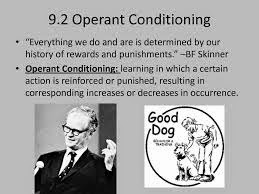
Keep in mind that all of this is talking about CHILDREN. In keeping with this month's theme, this graphic says it all. Skinner continued Thorndike's work:

Monday, October 6, 2014

Skinner's Incarnations

Day 6: Skinner Horror Files


“Please do not forget for one moment that OBE is mastery learning/direct instruction. The only difference between OBE and Direct Instruction is that OBE had very bad, outrageous... outcomes, and direct instruction has… those peanut butter-and-jelly-sounding phonics outcomes.”
– Charlotte Iserbyt, circa 1998,

p. A-156 the deliberate dumbing down of america


Saturday, October 4, 2014

What Is Direct Instruction?

Day 5: Skinner Horror Files

Skinner Troubles with Direct Instruction/Mastery Learning

The following blog post is an excerpt from Appendix XXV of my book the deliberate dumbing down of america. It is the second of a two-part alert series in the late 1990s that comprised this particular appendix. This is the best summary of what exactly Direct Instruction is. And why parents and citizens need to be concerned about this method being used in schools -- often under different names and guises.

“The Difference Between Traditional Education and Direct Instruction” by Tracey J. Hayes

The major difference between Traditional Education and Direct Instruction (DI) is the
method in which the content is taught.


Traditional education focuses on content-rich curriculum in which a particular subject is
“introduced, taught, and reviewed,” moving from simple to complex, spiraling back to refresh and retain previously learned material while progressing in that subject. Some publishing companies make recommendations on what content is to be taught, but in most traditional education classrooms, the teacher decides “how” the “what” is to be taught.


To help determine student achievement in traditional education, weekly quizzes and end-of-chapter tests are administered. One hundred percent mastery is, however, not expected. The teacher knows that with time and review, retention of knowledge and test scores will improve. The object of traditional education is to offer students a broad foundation of information, based on facts and figures, that will be retained for future application on high stakes assessments, education and career objectives, and life-long wisdom.


Traditional education is sometimes described as “direct instruction.” In traditional education the teacher stands in front of the classroom “directly instructing” the students in the subject matter. Direct instruction and teacher-directed instruction (used in traditional education) are examples of how words in our language can be perceived as being one and the same, when in fact they are very different from one another. Deceptive semantics has created much confusion among many educators as well as parents.


With traditional education, on Monday the teacher assigns her class a chapter to read on the subject of George Washington crossing the Delaware. She tells them they will be tested on this subject on Friday, but she doesn’t tell them exactly on what they will be tested. In other words, they must learn as much as they can about everything in the chapter—including the name of George Washington’s horse. When tested, the students might receive a 75% or 80% grade and some parents may be upset with what they consider a “low” grade. However, in fact, the students have done far better than students using mastery learning or direct instruction who are taught to the test, only learning that material on which the teacher tells them they will be tested and receiving a grade of 90–100%. The students in the traditional education class have actually learned many, many times more than the students in a mastery learning or direct instruction class, even though they did not have to use all they learned on their test. Professor Benjamin Bloom, the father of mastery learning, was certainly correct when he asserted that students could reach 85% mastery—of a limited or dumbed down curriculum.


Direct Instruction focuses on a narrow curriculum in which a particular subject is introduced via a stimulus, expecting a particular response from the student. Based on
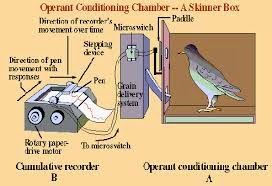
behavioral psychology and the work of B.F. Skinner, DI
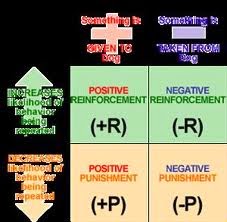
requires the teacher to use operant conditioning and behavior modification techniques. In a DI classroom the teacher must follow a prescribed set of lesson plans, sometimes in script form, and use certain cues such as clapping with the intent to incite a certain reaction such as unison chanting from the students. In many classrooms, rewards and tokens are also used to generate a predetermined response (S-R-S).


Direct Instruction is a teaching method that bypasses the brain and instigates a reflex
that is not natural, but rather controlled and programmed. This kind of manipulation causes some students to become so stressed that they become sick or develop nervous tics. Many DI programs are designed for the computer with built-in bells and whistles to “control and pace the learning outcomes.” With outcome-based education (OBE) already in many schools, Computer Assisted Learning (CAL), programmed with the ML/DI method, is also promoting affective/subjective goals.


Direct Instruction expects mastery (ML) to be achieved in each area of instruction before
moving onto the next level. There are frequent tests, cramming, cranking, and drilling the skills to perfection, so test scores are usually high in the early years. Typical classrooms, however, consist of students with varying abilities, so the amount of content is decreased to accommodate the slowest learner [dumbed-down, ed.]. In some schools cooperative learning is used to appease the high achiever. Since review of previously learned materials is not encouraged, overall retention is less. SAT scores are low, and ultimate application is not achieved and in some cases stifled.


Direct Instruction has been used for decades in areas where poverty is prevalent because the method of teaching promotes order and discipline in the classroom. Since many parents want to discard whole language and implement phonics, schools across the nation are adopting DI programs without truly understanding the method behind the content. At the expense of destroying one’s free will, these schools are training students to become passive drones rather than educated citizens. As students plateau at a certain level because they cannot make sense of the knowledge they once were expected to recall on command, one must wonder if the pressure to perform like barking dogs is what students really need or what we really want.

Who's Who and What's What

Day 4: Skinner Horror Files

The Next Generations of Programmed Instruction


This post is a history lesson taken directly out of my book the deliberate dumbing down of america, Appendix XXV. This appendix has two alerts that were sent out in the late 1990s that warned about how Skinner's form of operant conditioning education (the original Programmed Instructions discussed in Day 3's post) was continuing on with a life of its own in education, albeit under different names. The second alert will be posted on Day 5.

Names have been highlighted because they are important for understanding what has happened. These are not household names! But they are names well known to education reformers. And they have been directly and adversely affecting the education of your children and grandchildren for decades:

“The Truth about How We All Have Been Had” was my alert sent out in late 1998, after the passage of Omnibus Budget Bill for 1999 which contained the Reading Excellence Act.

Please bear with me. This alert is going to try to explain what happened on the slow road to teaching our children how to read....


First, I want to thank the loop for alerting me about two years ago to the activities of Doug Carnine, director of the federally funded National Center to Improve the Tools of Educators (NCITE) at the University of Oregon. By the way, folks, that is a federally funded office which has dealt for a very long period of time with programs for special education children. Carnine’s name jumped out at me when mentioned in one of the loop’s communications supporting direct, systematic, intensive phonics (direct instruction), which, by the way, is NOT TRADITIONAL PHONICS INSTRUCTION.


I immediately thought, “Wait a minute. What’s going on here? Is this the same Doug Carnine who was involved with Siegfried Engelmann’s Follow Through DISTAR program (now known as Teach Your Child To Read in 100 Easy Lessons or Reading Mastery), about whom I had written in my 1985 book Back To Basics Reform or… OBE Skinnerian International Curriculum?” Of course it was, and from that time on I devoted much time trying to convince parents that “direct instruction,” regardless of whether it is spelled with lower or upper case “d” and “i,” is based on the operant conditioning experiments with animals carried out by the Russian Ivan Pavlov and the American professor B.F. Skinner.


In January of 1997 I wrote many memoranda on this subject which were included on the Internet Education Loop website, identifying Carnine and Engelmann with Ethna Reid’s learning program which Ann Herzer (a traditional phonics reading teacher opposed to Skinnerian operant conditioning) so valiantly fought in the late ‘70s and early ‘80s. When Herzer objected to the training, she was asked, “Don’t you know we are training our children to be people pleasers?” [See Appendix XVII of this book, ed.] I pointed out that my 1985 book Back To Basics Reform Or... discussed the ECRI/DISTAR method. Many of us have fought this method for twenty years and, sad to say, we have gotten nowhere. I suppose that is to be expected since we are not part of the national conservative leadership nor are we part of the education establishment leadership. No one listens to you unless you are well funded and have fancy letterhead. Follow the money, follow the money. We didn’t have the resources to make a difference.


However, all is not lost if those of you who read this alert will take the necessary action to stop the funding of the Reading Excellence Act at the local level. Millions of tax dollars will be gushing forth in your communities to implement this Skinnerian reading program under the guise of “scientific, research-based” phonics reading instruction.


Let me quote from an October 1997 letter Doug Carnine wrote to “concerned friends” asking them to support H.R. 2614, The Reading Excellence Act, which called for the use of “research-based” reading instruction programs; i.e., his and Engelmann’s program (ECRI/DISTAR). Obviously, use of these programs could be of financial benefit to those involved in the development of the program. Carnine’s letter encouraged the following:
 

As you know, significant reforms are in process in the bellwether states of California and Texas as well as in many other states. State lawmakers, education leaders, and concerned citizens are joining forces to ensure that the wealth of scientific research on reading conducted during the past three decades is fully transformed into effective classroom reading instruction.

Much of the “scientific research” to which he refers is the Skinnerian dog-training method used in DISTAR and ECRI. Whenever you see the word “effective” related to education, realize that it relates to the late Ron Edmonds’s Effective School Research (Harvard and Michigan State). It says “almost all children can learn” when taught to the test, provided the necessary environment for that individual child and enough time for the child to “master” whatever the content (or workforce skills) is made available. That’s Skinnerian/behavioral terminology, for those who are not initiated. The new term for “environment” is now “positive school climate,” which takes the place of the behaviorist term “psychologically manipulative environment.” Effective School Research calls for the elimination of the Carnegie unit, norm-referenced testing, grade levels, etc. Effective School Research calls for outcome-based education, which is mastery learning and can include direct instruction. Both are closely related to Total Quality Management [TQM] and Planning, Programming, and Budgeting Systems [PPBS].


Of course, for those who don’t have any problem with this type of  education/training, STOP: you need read no further. For those who may have questions, please bear with me. 


First, you will want to be sure I am correct in my claim that this is, in fact, Skinnerian dog training. The final piece of the puzzle, which should be the clincher and for which many of us are most grateful (God works in wondrous ways!) came in the publishing of What Works in Education, edited by Crandall, Jacobson, and Sloane (Cambridge Center for Behavioral Studies: Cambridge, Massachusetts, 1997). The Center’s activities and publications can be accessed on their website (http://www.behavior.org). Following are some excerpts related to two of the nine programs discussed in this book:
What Works in Education is the result of a collaborative effort between two organizations: The Cambridge Center for Behavioral Studies and Division 33 of the American Psychological Association.... We would like to extend our gratitude to Doug Carnine, Professor of Education at the University of Oregon, and Bonnie Grossen, Editor of Effective School Practices, for consulting on this project.
The chapter entitled “Mabel B. Wesley Elementary” states:
The Mabel B. Wesley Elementary School in Houston, Texas, has had a schoolwide Direct Instruction language arts curriculum since 1976, and has implemented other direct instruction programs and other programs based on related approaches in other subject matters.... Dr. Thaddeus S. Lott, Sr. is the Project Manager for the Northwest Charter District and Mrs. Wilma Rimes is the principal of Mabel B. Wesley Elementary School.
In 1975... in searching for a means of improving reading skills, Dr. Lott, then the new principal, visited a campus that was implementing the DISTAR reading curriculum (see Direct Instruction for Teaching Reading and Remediation, Carnine and Silbert, 1979), developed by Engelmann (reported in Becker, Engelmann and Thomas, 1975A and 1975B). He was impressed by what he observed and began the implementation of DISTAR [now called Reading Mastery, ed.] in 1976.
The chapter entitled “Exemplary Center for Reading Instruction—ECRI” by Ethna R. Reid of the Reid Foundation states:
ABSTRACT: ECRI provides consulting and training for individual classrooms, grade levels, or entire schools in implementing a direct instruction model in language arts. The ECRI model is applied to and adapted for existing instructional materials. From these materials, structured lessons are developed to teach an integrated curriculum of phonics, oral and silent reading, comprehension, study skills, spelling, literature, and creative and expository writing. ECRI also includes rate building, mastery learning, and behavior management components.
ECRI identified effective teaching strategies later corroborated in the Follow Through Program (Stebbins, L.B., St. Pierre, R.G., Proper, E.D., Anderson, R.B., & Cerva, R.T., 1977) and now known as Direct Instruction (Jenson, Sloane & Young, 1988, pp. 335–336, 350–362). ECRI adopted a general direct instructional approach and expanded it... in ways that allowed application to existing subject material in any content area.
Can you not see that this is the necessary Skinnerian method for application to workforce training? Skinner said, “I could make a pigeon a high achiever by reinforcing it on a proper schedule.”


 The above ECRI connection with DISTAR (Reading Mastery), the direct instruction program being pushed all over the country (Thaddeus Lott’s Houston site is the best known) should come as no surprise since the developer of DISTAR, Siegfried Engelmann, has his work in Skinnerian operant conditioning cited several times in Ethna Reid’s Teacher Training Manual. Of interest is the fact that the U.S. Department of Education in 1981, when Ann Herzer tried to have ECRI shut down, lied in writing when it said ECRI did not use operant conditioning. I have all the correspondence regarding this controversy. A class action suit should be filed against the U.S. Department of Education for its role in promoting this type of training/ conditioning under the guise of “education” and for lying about the method.

In other words, ECRI and DISTAR are not just close cousins; they are, in fact, fraternal twins. The only difference between them is their name. They were both funded during the War on Poverty, Great Society 1960s, and since that time have been used on the most helpless members of our society, the underprivileged and minority children. Professors Benjamin Bloom and Lee Shulman’s 1968–1981 Chicago Mastery Learning Program was, according to a March 6, 1985 article in Education Week

a tragedy of enormous proportions with almost one-half of the 39,500 public school students in the 1980 freshman class failing to graduate, and only one-third of those graduating able to read at or above the national 12th grade level.
Of interest is the fact that claims of effectiveness similar to those made regarding the Houston DISTAR program were made by the elitist change agents during the 1970s and early 1980s. The Chicago Program crashed in 1981.


What happened to the students who participated in Chicago’s Skinnerian experiment? What happened to Lee Shulman, who was involved in the Chicago Mastery Learning disaster? Lee Shulman went on to become the Director of the Carnegie Foundation’s Board for Professional Teaching Standards, which is the architect of the performance-based (Skinnerian) teacher training model. Shulman, who had been a Fellow of the American Psychological Association and a Fellow of the Center for the Advancement of Behavioral Sciences, later became President of the Carnegie Foundation for the Advancement of Teaching. The reader should refer to the fact that the book What Works in Education is a result of a collaborative effort between the American Psychological Association and the Cambridge Center for Behavioral Studies. What rewards for such a disaster! The lives of the children involved in the experiment are not so decorously documented.


One simple question should be asked which should put this whole matter to rest: Why haven’t the underprivileged, the minorities, etc., had more academic success if these programs (which have been used in most of our inner cities under the guise of effective schooling practices) are in fact so “effective”? Why is it that some very good anti-OBE people out there don’t even realize that this method is OBE? It is based on [Benjamin] Bloom’s and [William] Spady’s contention (which, by the way, is embraced by the Soviets in their polytechnical training as well) that “all except the most seriously handicapped” children can learn, if they work at their own pace with an individualized education plan, are taught to the test, do not have to compete with classmates, are subject to criterion-referenced testing rather than norm-referenced testing, and have as long as they want to “master” the controllers’ outcomes, results, or competencies. Outcome-based mastery learning/direct instruction is what the United Nations is talking about when it refers to Lifelong Learning. Everyone can take as long as needed to “master” what the corporate and international planners want as long as everyone “masters” it, even if it takes a lifetime. God forbid that you may not want to master certain things. And don’t forget, it’s not just students but all of us who will be involved in this lifelong learning—unless, of course, Americans wake up and do something.


Whether either program has produced the gains proponents of the “method” suggest is questionable. The basic skills test results from Mission, Texas, which used ECRI for a period of twenty years, certainly are dismal. Much more documentation is required in this regard. By the time we have the sad truth regarding longitudinal test studies, including information on where the DISTAR-educated students are now or 10 years from now, and what they are doing, if anything, it will be too late. Norm-referenced testing will be a thing of the past. Performance-based testing (portfolios, demonstrations, etc.) will be standard, and we will have highways plastered with “My Son/Daughter Is an Honor Student.” We will never know how dumbed down our children are except when, instead of saying “Please, may I have the ketchup?” they simply grunt a certain number of times for ketchup and a certain number of times for butter, etc.


The basic question, however, aside from test scores, remains: Is it moral to use this method on children in the classroom without their informed consent, even if results show small and temporary gains? There are laws on the books which give prisoners protection against such behavior modification methods. Medical research is available showing that operant conditioning causes psychological, neurological, and medical problems. Children in the ECRI program have exhibited such symptoms. There are doctors’ statements to this fact.


For those who still don’t believe that DISTAR (Reading Mastery) is the same as ECRI, let me quote from a few pages of a dissertation by a top state department of education official who does not wish to have it attributed to him. The paper, written in 1986, entitled “The Exemplary Center for Reading Instruction—ECRI,” states in part:

One of the major goals was to do a cost-effectiveness study to ascertain the most beneficial time to introduce academic skills to students. The only break the children had during their instruction was a snack time which was used as a language experience to discuss the various foods the children were eating. The main instructional unit was the SRA DISTAR Program. The results showed an increase in pupil IQ of approximately 20 points in the first year of the program and elimination of a great many behavioral problems. [emphasis added]

Facts Established
  1. ECRI and DISTAR are fraternal twins, and both use Skinnerian operant conditioning.
  2. Operant conditioning is based on Pavlov’s experiments with slobbering dogs.  
  3. The Right to Read Foundation, formerly headed by Robert Sweet, supports Teaching Your Children to Read in 100 Easy Lessons, which is SRA’s DISTAR (Mastery Reading). Sweet  recently became a consultant to the House Education and Workforce Committee and helped draft and promote the Reading Excellence Act. Several years ago when Tracey Hayes, a researcher, brought her concerns regarding the Carnine/Engelmann program to his attention, Sweet told her he saw nothing wrong with mastery learning. Good parents looking for traditional phonics-based reading instruction for their children have been had by the master manipulators’ use of the Hegelian dialectic. They (the internationalist change agents) created the whole language disaster (or took advantage of it) in order to get parents to scream so that parents could be offered the predetermined solution: the direct instruction Skinnerian program which can be applied to any other disciplines, including WORKFORCE TRAINING!
And the desperate parents have bought into this shameful scam, thinking that the educational establishment really cared about their children learning to read. The corporate sector, which supports direct instruction, does not really want educated workers. Thomas Sticht, a member of the Secretary’s Commission on Achieving Necessary Skills (SCANS) said as much when he was quoted in an August 17, 1987 Washington Post article as follows:

Many companies have moved operations to places with cheap, relatively poorly educated labor. What may be crucial, they say, is the dependability of a labor force and how well it can be managed and trained—not its general educational level, although a small cadre of highly educated creative people is essential to innovation and growth. Ending discrimination and changing values are probably more important than reading in moving low-income families into the middle class.
Sticht was also at one time associated with the “Hooked on Phonics” program. Oh, what a tangled web we weave! Harvard’s Professor Anthony Oettinger, a member of the Council on Foreign Relations, which is bringing us [School-To-Work] STW, Free Trade and Global Governance, said in 1981:
The present “traditional” concept of literacy has to do with the ability to read and write. But the real question that confronts us today is: How do we help citizens function well in their society? How can they acquire the skills necessary to solve their problems? Do we really have to have everybody literate—writing and reading in the traditional sense—when we have the means through our technology to achieve a new flowering of oral communication? It is the traditional idea that says certain forms of communication such as comic books are “bad.” But in the modern context of functionalism they may not be all that bad. [emphasis added]
All that one must do to smell one big rat is ask the questions....

Friday, October 3, 2014

Hooking Children to Computers

Day 3: The Skinner Horror Files

Programmed Instruction: An Introduction
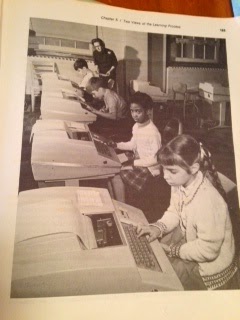
Exhibit 1, p. 163
Exhibit 1 is from a 1971 textbook Psychology Applied to Teaching by Robert F. Biehler (Houghton Mifflin Co., Boston). This photo illustrates the early use of Skinner's PROGRAMMED INSTRUCTION in the classroom using a "teaching machine" computer.  In order to understand what has been happening in education reform that past half century, it is first necessary to understand Skinner's Programmed Instruction. It would go on to be developed, adapted, and expanded, and even given new names (Mastery Learning, Direct Instruction, etc.).

Exhibit 2, p. 162

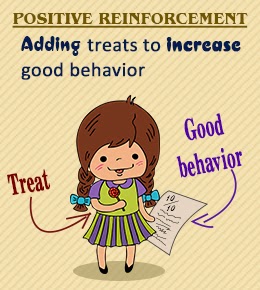
Text from page 162 (Exhibit 2) describes how the programmed means of instruction was accomplished via a computer flow chart. Keep in mind as you look at this, that Skinner's METHOD provided "reinforcement" - i.e., conditioning the child to respond correctly through behavior modification. So this wasn't simply a spelling exercise!

"...the key idea behind Skinner's technological approach [was] that the learning of students in school should be shaped by a series of reinforcements." (p. 159, emphasis in original)

In his book The Technology of Teaching, Skinner wrote that

"[The two basic considerations of programmed learning are] the gradual elaboration of extremely complex patterns of behavior and the maintenance of the behavior in strength in each stage. The whole process of becoming competent in any field must be divided into a very large number of very small steps, and reinforcement mut be contingent upon the accomplishment of each step.... By making each successive step as small as possible, the frequency of reinforcement can be raised to a maximum, while the possibly aversive consequences of being wrong are reduced to a minimum." (p. 159, emphasis added, citing Skinner, 1968, pp. 21-22)

Scholarly criticisms of Programmed Instruction were mentioned in this old college textbook:
  • "...the theory is based on experiments performed on lower animals and... the student working on a program is being treated like an animal."
  • "...programmed learning produces regimentation and limits creativity."
  • "...many programs are designed so that the student will answer almost every response correctly [dumbing down, ed.]....[E]asy material may be forgotten quickly... "
  • "...the student will fail to develop perseverance and hence be unable to cope with difficult problems later on."
  • "...programmed learning is just a glorified version of animal-training techniques which  have been known and practices for centuries...."
  • "...machines will eventually replace teachers." (pp. 166-167)
Exhibit 3, p. 171, "the lowest common denominator" admission
In Exhibit 3 can be seen the startling admission that "programmers are forced to keep revising programs for the lowest common denominator--the slowest students in the group," which can lead "to programs which are oversimplified and repetitious." More evidence of a dumbing down. Note the other criticisms on this paragraph of page 171.

On page 172 teachers are given a series of warnings, that include the ominous first statement: "Remain aware of the extent and disadvantages of aversive control." An admission that this isn't just about positive reinforcement. The Skinnerian system, despite the glossy "spin" to the contrary, always requires rewards AND penalties in order to work. 
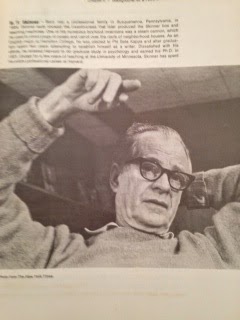
Exhibit 4, p. 27

Finally, take note of the fact that to Skinner the child was referred to as an "organism." This was a continuous progress system, in which the student could be manipulated to progress through stages of learning. This belief is founded upon evolution. "In the eyes of an advocate of guided experience the child is an organism which develops and learns by passing through a precise sequence of stages." (p. 32)

This idea took root. Skinner's utopian system would go on to be applied  to organizations in society (also considered to be "organisms"). It would be applied by New Agers who desired to facilitate an evolution of the species. And Social Engineers such as David Hornbeck would go on to propose the Skinnerian ideal of rewarding schools, teachers and children that performed up to par, and penalizing those that didn't.

Thursday, October 2, 2014

Leave it to Bill!

Day 2: The Skinner Horror Files

It depends on what the meaning of the word "charters" 'is'...

Salon article published HERE
Here are excerpts from the Salon article above:
Bill Clinton weighed in on the debate over charter schools this week, warning that the publicly funded yet autonomous schools must keep their “original bargain” if they want support as alternatives to traditional public schools.

The Huffington Post reports that in remarks before a dinner hosted by the Clinton Global Initiative on Tuesday, the former president hailed the potential of charter schools, even as he called on them to be held to high standards. Clinton cited New Orleans, whose post-Katrina public schools are 100 percent charter. While casting New Orleans’ experience with charters as a success story, he added an important caveat. Charter schools aren’t worth supporting, Clinton suggested, unless they perform better than traditional public schools.

“They still haven’t done what no state has really done adequately,” Clinton told the group, “which is to set up a review system to keep the original bargain of charter schools, which was if they weren’t outperforming the public model, they weren’t supposed to get their charter renewed.”

Clinton’s statement is stunning once you consider its implications. Research shows that the vast majority of charter schools in the U.S. haven’t cleared that hurdle....
[emphasis added]

Bill Clinton's comments before an elitist group of wealthy "globalists" is a jaw dropper. 

What kind of balloon is he floating?  We know he and his internationalist friends are depending on using the schools (lifelong, not just K-12) to train for the global workforce, so what's Bill got in his pocket as a possible substitute for charter schools?

To be perfectly honest, I haven't a clue!

Huffington Post, 9/24/14,
"Bill Clinton: Charter Schools must Hold to 'The Original Bargain'"


Is Clinton's ambiguity a rerun of his comment during Lewinskygate? 
"It depends on what the meaning of the word 'is' is", in regards to the truthfulness of his statement that "there is not a sexual relationship, an improper sexual relationship or any other kind of improper relationship." [Lewinsky scandal]
Is what he is saying a semantic rerun: "It depends on what the meaning of the word "charters" 'is'?

Were charter schools used as the initial experiment in order to get public acceptance of public/private partnerships and unelected boards? 

There has been little discussion of the dangers of such a system, while the nation has been, thanks to the neoconservatives, focused 110% on the nasty Communist Core. Any discussion of tax-funded school choice/charters with unelected boards has been avoided like the plague.  Except on this blog.
Read my post "The Deliberate Dumbing Down of the Village."

Here are some little known facts about Clinton found in my book the deliberate dumbing down of america. From an Atlantic Monthly article, July 1997 titled "The Computer Delusion" by Todd Oppenheimer, we learn Clinton's philosophy about computerized learning (Skinnerian):
The noted psychologist B.F. Skinner, referring to the first days of his “teaching machines,” in the late 1950s and early 1960s wrote, “I was soon saying that, with the help of teaching machines and programmed instruction, students could learn twice as much in the same time and with the same effort as in a standard classroom.” Ten years after Skinner’s recollections were published, President Bill Clinton campaigned for a “bridge to the twentyfirst century... where computers are as much a part of the classroom as blackboards.” [emphasis added] (p. 381)
And from The Arizona Republic in an AP report in its October 23, 1998 issue, in an article titled "Charter Schools Bill Now Law," we learn how CHARTER schools were promoted by Clinton and the Democratic Party:
President Clinton on Thursday signed the Charter School Expansion Act of 1998 to speed the development of high-quality charter schools, a key element of his education agenda. The law authorizes up to $100 million a year over the next five years for the planning and expansion of charter schools. Clinton cited the charter schools legislation as an example of bipartisan cooperation....
Clinton has set a goal of 3,000 charter schools nationwide by the time he leaves office....[emphasis added] (p. 428)

Charter schools are obliged to adhere to federal guidelines, and are unaccountable to the taxpayers due to their being run by unelected councils; i.e., taxation without representation. Outside of such parental, voter and citizen oversight, they become a seedbed for experimentation on this nation's children. 
Sometimes what looks like "choice" isn't choice at all.

Wednesday, October 1, 2014

The Skinner Horror Files

31 Days of B.F. Skinner Horror Stories 

Because so much education reform rests upon Skinner's methods and ideologies, it is time to tell the truth. The next 31 days this blog will be posting current and historical information about the true nature of Skinner's "education" that has been foisted upon our nation's children. 


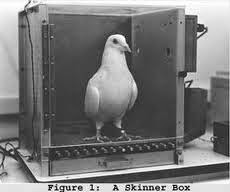
“I could make a pigeon a high achiever
by reinforcing it on a proper schedule.”

-B.F. Skinner

 "Almost all major problems involve human behavior,
and they cannot be solved by physical
and biological technology alone.
What is needed is a technology of human behavior."
-B.F. Skinner, Beyond Freedom and Dignity

(Source)

In 1968 B.F. SKINNER: THE MAN AND HIS IDEAS by Richard I. Evans was published (Dutton and Company: New York, 1968). Here are some key Skinner quotes with a comment by Evans:
“I could make a pigeon a high achiever by reinforcing it on a proper schedule.”
... His [Skinner’s] concern for what he believes to be the inadequacy of our formal education system led to applying the principles of operant conditioning to a learning system which he called the teaching machine, but Skinner’s approach is concerned with more than merely methods and techniques. He challenges the very foundations by which man in our society is shaped and controlled. (p. 10)
“[F]or the purpose of analyzing behavior
we have to assume man is a machine."
(p. 24)
"You can induce him to behave according to the dictates of society
instead of his own selfish interest.”
(p. 42)
“I should not bother with ordinary learning theory....
I would eliminate most sensory psychology and
I would give them no cognitive psychology whatsoever

[meaning the students, ed.].”(p. 91)

“ It isn’t the person who is important, it’s the method. If the practice of psychology survives, that’s the main objective. It’s the same with cultural practices in general: no one survives as a person.”(p. 96)
“It does bother me that thousands of teachers don’t understand, because immediate gains are more likely in the classroom than in the clinic. Teachers will eventually know—they must [understand]—and I am more concerned with promoting my theories in education [operant conditioning].”(p. 96)
“I should like to see our government set up a large educational agency in which specialists could be sent to train teachers.”(p. 109)
http://en.wikipedia.org/wiki/Beyond_Freedom_and_Dignity
In 1953 Skinner wrote Science and Human Behavior (Macmillan & Co.: New York, 1953), within which is found the following quote:
"A rather obvious solution is to distribute the control of human behavior among many agencies which have so little in common that they are not likely to join together in a despotic unit. In general this is the argument for democracy against totalitarianism. In a totalitarian state all agencies are brought together under a single super-agency."

Obviously, even before the U.S. Department of Education was established and organized teacher in-service training had taken a behaviorist (performance-based) turn, Skinner was advocating these very operant conditioning methods in all phases of education. Beginning in 1965, the federal government implemented several teacher education programs based on performance —performance-based teacher education—which would fulfill Skinner’s plan. Skinner was always more concerned with “how” teachers teach than with “what” teachers teach.

One must never forget that this is all about our children. Stay tuned in the next 31 days!

For the full context of these remarks and quotes above, see my book the deliberate dumbing down of america, available freely online as a downloadable document.